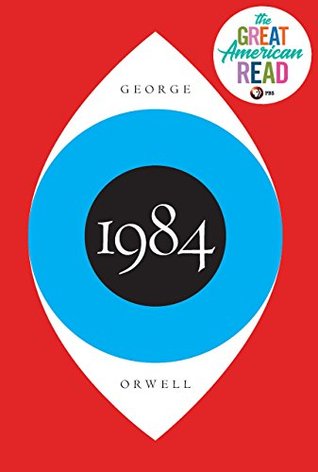
George Orwell’s 1984, published in 1949, is a dystopian novel set in a totalitarian future state called Oceania, ruled by an omnipotent Party led by the enigmatic figurehead Big Brother. The story follows Winston Smith, a low-ranking Party member who works at the Ministry of Truth, where his job is to rewrite historical records to match the Party’s ever-shifting version of reality. Quietly rebellious and haunted by fragmented memories of a freer past, Winston begins a forbidden love affair with a woman named Julia and cautiously seeks contact with what he believes is an underground resistance movement. Orwell’s prose is spare and precise, carrying an atmosphere of permanent dread that intensifies as Winston’s small acts of defiance lead him toward inevitable catastrophe.
At the heart of the novel is an unflinching examination of how authoritarian power sustains itself — not merely through force, but through the systematic destruction of truth, language, and inner life. The Party’s mechanisms of control include constant surveillance via telescreens, the manipulation of history, the deliberately impoverished language of Newspeak designed to make dissenting thought literally unthinkable, and the psychological terror of the Thought Police. Orwell draws on the totalitarian regimes of the twentieth century — Stalinist Soviet Union, Nazi Germany — while constructing something universal: a portrait of power that wants not just obedience but the complete annihilation of the self. The novel’s famous concluding insight — that Winston, after his torture and psychological breaking in the Ministry of Love, genuinely comes to love Big Brother — stands as one of literature’s most devastating endings.
Key takeaways
- Doublethink is the Party’s core psychological tool: the trained ability to hold two contradictory beliefs simultaneously and accept both as true, allowing the regime to rewrite reality without ever acknowledging the contradiction.
- Newspeak, the Party’s engineered language, illustrates Orwell’s conviction that thought is shaped by language — shrink the vocabulary enough, and certain rebellious or nuanced ideas become cognitively impossible to form.
- The mutability of the past is the Party’s most fundamental weapon. By controlling all records and memory, it controls objective truth itself, encapsulated in the slogan “Who controls the past controls the future; who controls the present controls the past.”
- The Party’s goal is power for its own sake, not ideology, prosperity, or any utopian end — as the interrogator O’Brien explains to Winston at length. This distinguishes Orwell’s vision from naive readings of totalitarianism as merely misguided idealism.
- The proles, the vast working-class majority, are theoretically the only group with the numbers to overthrow the Party, yet they remain too atomized and distracted to organize — a bleak commentary on class consciousness and political apathy.
- Torture does not just extract confession; it reshapes belief. The horror of Room 101 is that it is calibrated to each individual’s deepest fear, ensuring not just compliance but genuine psychological capitulation — the destruction of the inner self the Party cannot otherwise reach.
- Julia and Winston’s relationship represents the last refuge of private humanity — physical love, loyalty, and personal experience — making the Party’s ultimate success in turning them against each other the novel’s most intimate and crushing defeat.