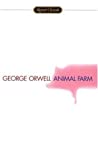
George Orwell’s Animal Farm is a short allegorical novella published in 1945, in which the animals of Manor Farm revolt against their drunken, neglectful owner, Mr. Jones, and attempt to run the farm themselves. What begins as an idealistic experiment in collective self-governance — inspired by the dying vision of an old boar named Old Major — gradually collapses into tyranny as the pigs, led first by the rival figures of Snowball and Napoleon, consolidate power and exploit the very animals they once claimed to liberate. The story is a pointed satire of the Soviet Revolution and Stalinist regime, though its themes extend to the mechanics of political corruption and propaganda in any era.
Orwell’s prose is deceptively simple, almost fable-like in its clarity, which makes the creeping horror of the farm’s descent all the more effective. The novella reads quickly, but its images — the rewriting of the commandments, the show trials, the slow transformation of the pigs into something indistinguishable from humans — linger long after the final page. The genius of the form is that Orwell uses the barnyard setting not to soften the political critique but to sharpen it, stripping away the ideological camouflage that obscures real-world authoritarianism and rendering its essential logic nakedly visible.
What makes Animal Farm endure beyond its Cold War context is its unflinching diagnosis of how revolutions betray themselves. The working animals — loyal, hardworking Boxer the horse above all — are not stupid, but they are trusting, and that trust is methodically weaponized against them. The pigs do not seize power all at once; they do so incrementally, rewriting history, silencing dissent, and manipulating language until “All animals are equal, but some animals are more equal than others” can be painted on the barn wall without apparent irony. Orwell suggests that the failure belongs not only to the corrupt leaders but to the structures — and the silences — that allow them to operate.
Key takeaways
-
Revolution can reproduce the oppression it overthrows. The animals expel Mr. Jones only to find themselves, years later, under a pig dictatorship that mirrors and eventually merges with the human farmers they once despised. The final scene, in which the animals watching through a window can no longer tell pig from man, is the novella’s devastating thesis statement.
-
Language is the primary instrument of control. The pigs’ greatest weapon is not physical force but the manipulation of the Seven Commandments — quietly altered in the night — and the rhetorical brilliance of Squealer, who can make any betrayal sound like a sacrifice made for the animals’ benefit. Orwell anticipates his later, fuller exploration of Newspeak in Nineteen Eighty-Four.
-
Loyalty and hard work are not enough without critical thinking. Boxer’s motto — “I will work harder” and “Napoleon is always right” — is portrayed with genuine pathos but also as a tragic flaw. His unquestioning devotion makes him the regime’s most valuable asset and, ultimately, its most easily discarded one.
-
Propaganda requires a villain as much as a hero. Snowball, likely based on Leon Trotsky, is transformed in absentia into the scapegoat for every failure and misfortune on the farm. The pigs demonstrate how a purged enemy can serve authoritarian power indefinitely as a source of fear and blame.
-
Gradual normalization makes tyranny possible. No single dramatic moment marks the point of no return. The erosion of the animals’ rights happens in small steps — a privilege here, a rule change there — each one rationalized until the complete reversal of the revolution’s principles seems almost natural.
-
Collective memory is fragile and easily falsified. The animals often sense that things were not always as they are told, but they cannot quite remember the past clearly enough to resist the official version. Orwell implies that the inability or unwillingness to maintain honest memory is central to how authoritarian systems sustain themselves.