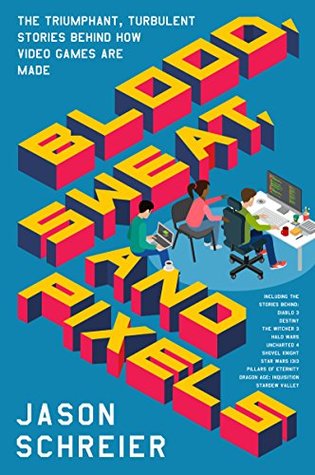
Jason Schreier’s Blood, Sweat, and Pixels is a behind-the-scenes examination of video game development, told through ten case studies of games made between roughly 2010 and 2016. A reporter for Kotaku who spent years covering the games industry, Schreier conducted hundreds of interviews with developers at studios large and small to produce a work that is equal parts celebration and exposé. The book’s central argument is deceptively simple: making video games is extraordinarily hard, and almost every finished game represents a minor miracle of sustained human effort against overwhelming odds — technical, financial, creative, and personal.
Each chapter focuses on a different game — including Destiny, The Witcher 3, Shovel Knight, Stardew Valley, Diablo III, Dragon Age: Inquisition, and Star Wars Battlefront — and traces its development from conception to ship date. Schreier is a clear, accessible journalist rather than a literary stylist, and his prose is brisk and anecdote-driven. He lets developers speak at length in their own words, which gives the book an unusual intimacy. The cumulative effect is a portrait of an industry defined by “crunch” — the punishing overtime culture in which developers routinely work sixty, eighty, or even one hundred hours a week in the months before a game’s release — alongside genuine passion that keeps people in the field despite the personal costs.
What makes the book more than a collection of developer war stories is Schreier’s consistent attention to systemic pressures. Publishers set deadlines that studios must meet regardless of a game’s state of readiness. Budgets balloon into the tens or hundreds of millions of dollars, making every delay catastrophically expensive. Scope creep, engine switches, leadership changes, and shifting market conditions can derail a project at any stage. Schreier presents these forces not to excuse poor management but to help readers understand why so many games ship broken, why studio closures follow even successful releases, and why the romantic image of game development as playful creative work is so often at odds with the reality experienced by the people doing it.
Key takeaways
-
Crunch is structural, not accidental. Across nearly every studio profiled, brutal overtime is not an aberration but a predictable consequence of how the industry prices and schedules work. Developers frequently sacrifice health, relationships, and sleep to ship on time, and many leave the industry within a few years as a result.
-
Scope is the silent killer. Games like Destiny and Dragon Age: Inquisition illustrate how ambition, technology changes, and shifting design visions can cause a project to balloon far beyond its original concept, forcing developers to cut years of work in the final stretch and sometimes ship something quite different from what was originally imagined.
-
Small studios face different but equally brutal pressures. The chapters on Shovel Knight (Yacht Club Games) and Stardew Valley (a one-man project by Eric Barone, known as ConcernedApe) show that independence from a publisher doesn’t eliminate suffering — it just relocates it, replacing corporate dysfunction with financial terror, isolation, and the weight of total personal responsibility.
-
“It ships when it ships” is rarely true. Despite public statements suggesting otherwise, virtually every game in the book had hard deadlines driven by retail commitments, fiscal calendars, or platform holder requirements. The fiction of unlimited development time is largely marketing language.
-
Success doesn’t guarantee stability. Several studios profiled experienced layoffs or closure shortly after shipping well-reviewed, commercially successful games, underlining how precarious employment in the industry remains even at its best.
-
Developer passion is both the industry’s greatest asset and its most exploited resource. Publishers and studios rely on the fact that many developers love their work deeply enough to absorb conditions they would not accept in other industries. Schreier treats this passion with respect while also making clear how routinely it is taken advantage of.
-
Transparency between developers and the public is rare and valuable. One of the book’s implicit arguments is that players who understand what game development actually involves become more thoughtful consumers — more patient with delays, more skeptical of hype, and more aware of the human cost behind the products they buy.