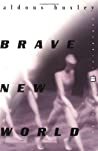
Aldous Huxley’s Brave New World (1932) is a landmark work of dystopian fiction set in a future World State where humanity has been engineered for stability, productivity, and contentment at the cost of freedom, individuality, and truth. Society is organized around the mass production of human beings — sorted into castes from the intellectually superior Alphas down to the deliberately stunted Epsilons — all conditioned from birth to love their predetermined roles. Pleasure is industrialized, dissatisfaction is medicated away with a drug called soma, and the very concepts of family, religion, art, and genuine emotion have been abolished as threats to social order. Huxley’s vision is less about jackbooted tyranny than about a softer, more insidious control: a world where people are not oppressed into submission but engineered into it.
The novel follows Bernard Marx, a slightly misfit Alpha who feels vague unease with a world he cannot quite reject, and Lenina Crowne, a cheerfully conventional woman who embodies everything the World State intends. Their visit to a Savage Reservation in New Mexico introduces John, a young man raised outside the World State on a diet of Shakespeare and raw human experience. John — the so-called Savage — becomes the book’s moral center and its most tragic figure. Transplanted to London, he is simultaneously exotic spectacle and genuine dissident, a man who demands the right to be unhappy, to suffer, to believe in something. His collision with the World State’s grand architect, the Controller Mustapha Mond, produces the novel’s most philosophically charged passages, in which the competing claims of happiness and meaning are argued with clarity and wit. Huxley’s prose throughout is elegant and satirically sharp, blending scientific extrapolation with mordant social comedy.
Key takeaways
-
Stability over humanity: The World State’s supreme value is social stability, achieved by eliminating the conditions that produce genuine individuality — family bonds, religious longing, artistic ambition, and suffering itself. The motto “Community, Identity, Stability” reveals what has been sacrificed for what.
-
Conditioning as the deepest control: Physical force is almost unnecessary in Huxley’s dystopia. Hypnopaedia (sleep-teaching), Pavlovian conditioning in infancy, and constant low-level pleasure keep citizens compliant far more effectively than coercion, anticipating later ideas about soft power and manufactured consent.
-
Soma as the perfect drug of oppression: The soma pill — which delivers euphoria with no hangover and no consequence — represents the ultimate pacifier. It is not escapism incidentally offered but escapism deliberately engineered as a political instrument, dulling any impulse toward dissatisfaction or transcendence.
-
Consumption as civic duty: Citizens are conditioned to spend, discard, and consume continuously. The World State runs on perpetual economic activity, and any inclination toward self-sufficiency, solitude, or contemplation is socially deviant. “Ending is better than mending” is one of many hypnopaedic slogans that have replaced genuine values.
-
John the Savage’s dilemma: John’s tragedy is that he has no viable world to inhabit. The Reservation is squalid and cruel; the World State is comfortable and hollow. His insistence on authenticity — on the right to God, poetry, danger, and grief — makes him an object of fascination but not a model anyone will follow, exposing the terrifying fragility of humanist values when comfort is on offer.
-
The Mustapha Mond argument: The Controller’s conversations with John and with Bernard’s exiled friend Helmholtz articulate the book’s central dilemma with unusual fairness. Mond genuinely understands what has been lost; he simply judges the trade worthwhile. This gives the dystopia an intellectual honesty that makes it more disturbing than a cruder villain would.
-
A warning about happiness itself: Unlike Orwell’s Nineteen Eighty-Four, which fears a boot on the face, Huxley’s novel fears the willing surrender of depth for comfort. Its enduring relevance lies in the question it keeps asking: if people can be made to love their servitude, is the servitude any less complete?