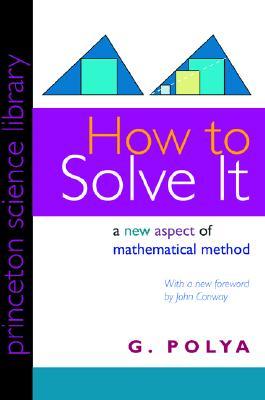
George Pólya’s How to Solve It, first published in 1945, is a slim but remarkably influential guide to the art of mathematical problem-solving. Pólya, a Hungarian-American mathematician, distills decades of teaching experience into a practical framework that transcends mathematics itself, offering a way of thinking applicable to any domain where problems must be confronted and worked through. The book is addressed to teachers as much as students, and its central argument is that problem-solving is not a mysterious gift but a learnable craft — one that can be nurtured through conscious attention to method and habit of mind.
At the heart of the book is a four-phase framework: understanding the problem, devising a plan, carrying out the plan, and looking back. Pólya elaborates on each stage through a kind of Socratic dialogue, modeling the internal questions a good problem-solver asks — “What is the unknown? What are the data? Have you seen this problem before in a slightly different form?” The second half of the book functions as a short dictionary of heuristics, defining terms like “analogy,” “auxiliary problem,” “decomposing and recombining,” and “working backwards,” illustrating each with mathematical examples ranging from elementary geometry to more advanced topics. Pólya’s prose is patient, warm, and gently ironic; he writes as a wise teacher standing just over your shoulder, coaxing rather than lecturing.
Key Takeaways
- The four-phase method — understand the problem, devise a plan, carry out the plan, look back — provides a universal scaffold for tackling unfamiliar problems without panic or aimlessness.
- Heuristics over algorithms: Pólya champions flexible rules of thumb (heuristics) rather than rigid procedures, arguing that the ability to mobilize the right heuristic at the right moment is what separates good problem-solvers from poor ones.
- The “look back” step is often neglected but crucial: reviewing a completed solution — checking it, finding alternative proofs, generalizing the result — is where deep understanding is actually built and where future problem-solving capacity grows.
- Analogy and generalization are among the most powerful tools available; recognizing that a new problem resembles a solved one, or that a specific result is a special case of something broader, frequently unlocks a path forward.
- Working backwards — starting from the desired conclusion and asking what conditions would be sufficient to reach it — is a systematically underused strategy that can cut through apparent dead ends.
- Teaching implications: Pólya argues that mathematics education fails students when it presents only polished solutions rather than the messy, questioning process by which solutions are actually found; teachers should model genuine problem-solving thinking aloud.
- The method is domain-general: although all examples are mathematical, Pólya explicitly frames heuristic reasoning as applicable to puzzles, practical decisions, and scientific inquiry, making the book’s lessons portable well beyond the mathematics classroom.