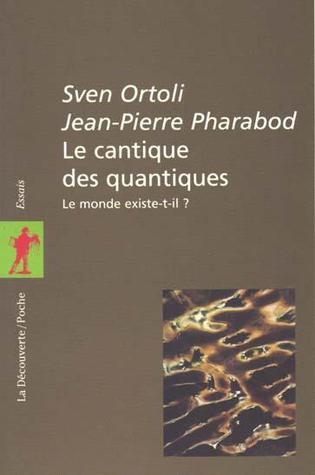
Le cantique des quantiques is a French popular-science book that sets out to make quantum mechanics genuinely accessible to a general audience, without sacrificing intellectual honesty about just how strange the theory really is. Written by science journalist Sven Ortoli and physicist Jean-Pierre Pharabod, the book combines rigorous explanation with philosophical reflection, guiding the reader from the historical origins of quantum theory — Planck’s discovery of the quantum of action, Einstein’s photons, Bohr’s atomic model — through to the full, unsettling strangeness of wave-particle duality, the uncertainty principle, and the measurement problem. The tone is lively and often playful, leaning on thought experiments, historical anecdotes, and literary flourishes to convey ideas that resist ordinary intuition.
What makes the book distinctive is its refusal to paper over the deep conceptual difficulties that quantum mechanics poses. Ortoli and Pharabod are frank about the fact that physicists themselves do not agree on what quantum theory means, even as they agree almost perfectly on what it predicts. The authors walk the reader through the major interpretations — Copenhagen, the many-worlds interpretation, hidden-variable theories — presenting each with its strengths and its philosophical costs. The result is a book that treats quantum mechanics not just as a set of techniques but as a profound challenge to our notions of reality, causality, and the role of the observer. The writing is accessible in the best French tradition of vulgarisation scientifique: elegant, engaged, and unafraid of genuine difficulty.
Key takeaways
-
The quantum world defies classical intuition at every turn. Particles do not have definite positions or momenta until they are measured; they exist in superpositions of states, and any attempt to observe them inevitably disturbs what is being observed. The authors present this not as a limitation of our instruments but as a fundamental feature of nature.
-
Wave-particle duality is not a paradox to be resolved but a reality to be accepted. Light and matter behave as waves in some experimental contexts and as particles in others. The book explains the double-slit experiment in careful detail to show why this duality is not a quirk but a cornerstone of quantum theory.
-
Heisenberg’s uncertainty principle is ontological, not merely epistemological. The authors stress that the impossibility of simultaneously knowing a particle’s exact position and momentum is not about the clumsiness of measurement; it reflects something true about the structure of reality itself, rooted in the mathematical formalism of the theory.
-
The measurement problem remains genuinely unsolved. The act of observation causes a quantum system’s wave function to “collapse” from a superposition into a definite state — but the theory itself offers no mechanism for this collapse. Ortoli and Pharabod treat this honestly as one of the deepest open questions in physics and philosophy.
-
The Copenhagen interpretation is dominant but philosophically evasive. The orthodox position — associated with Bohr and Heisenberg — instructs physicists to use the formalism and not ask what is “really” happening between measurements. The authors respect this pragmatism while acknowledging that many physicists find it unsatisfying.
-
Bell’s theorem and the experiments it inspired have profound implications for the nature of reality. The book explains how John Bell’s inequalities, and their experimental violation (notably in Alain Aspect’s experiments), effectively ruled out local hidden-variable theories, suggesting that quantum correlations are genuinely non-local — a result Einstein would have found deeply troubling.
-
Quantum mechanics forces a renegotiation of the boundary between observer and observed. Whether or not consciousness plays any special role (a question the authors handle with appropriate scepticism), the theory makes it impossible to treat the observer as a neutral, external presence. This has reverberations well beyond physics, touching on epistemology and the philosophy of science more broadly.