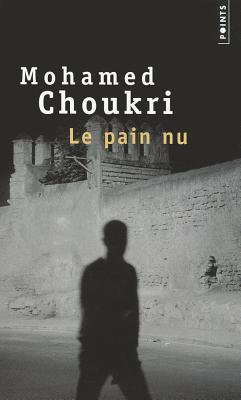
Mohamed Choukri’s Le Pain Nu (originally written in Arabic as Al-Khubz al-Hafi and translated into French by Tahar Ben Jelloun before appearing in English as For Bread Alone) is a raw, unflinching autobiographical novel recounting the author’s childhood and early adulthood in the brutal poverty of northern Morocco and the Spanish enclave of Tangier. Born into a family ravaged by hunger, violence, and despair, Choukri narrates his own formation — or deformation — by circumstances that left little room for tenderness. The book opens in the rural Rif region during famine, follows the family’s desperate migration to Tangier, and charts the young Mohamed’s immersion in the street life of that port city: begging, petty crime, prostitution, kif, and alcohol. It is a memoir written with the bluntness of someone who has nothing left to protect.
What makes the book remarkable is not merely its documentary honesty but the quality of Choukri’s prose, even in translation — spare, direct, almost affectless, yet capable of sudden lyrical ruptures. He does not sentimentalize suffering or seek the reader’s sympathy through self-pity. Violence, including the murder of his infant brother by his own father, is rendered with a terrifying flatness that makes it more, not less, disturbing. Choukri did not learn to read and write until he was twenty years old, and the book carries within it the urgency of someone who discovered language late and uses it as an act of survival and reclamation. Published in English in 1973 with a preface by Paul Bowles, who recognized in it a fierce authenticity, it was banned in Morocco for decades precisely because of its refusal to romanticize or conceal.
Key takeaways
-
Poverty as systematic brutality: Choukri shows how extreme deprivation does not ennoble people but distorts them — his father is cruel and broken in equal measure, his mother trapped, and the children are casualties of a system that offers no exit. Hunger shapes every relationship and every moral calculation.
-
The street as school: Tangier’s underworld — its cafés, brothels, smugglers, and addicts — becomes the only education available to the young Choukri. He learns to survive through transgression, and the book refuses to moralize about this; survival is presented as its own justification.
-
Late literacy as liberation: Choukri’s decision to learn to read and write as an adult is the quiet turning point of the narrative. Language becomes the instrument through which he transforms lived chaos into something that can be examined, ordered, and communicated — the book itself is evidence of this transformation.
-
Unflinching witnessing over redemption arc: Unlike many coming-of-age memoirs, Le Pain Nu does not offer a clean narrative of redemption or uplift. Choukri is honest about his own cruelties, desires, and failures, and the book ends not with triumph but with a tentative, fragile openness to possibility.
-
The body as site of record: Physical sensation — hunger, cold, sexual desire, the effects of alcohol and kif, the pain of beatings — is rendered with extraordinary precision. The body is the primary archive of a life lived without institutions, documents, or stability.
-
Tangier as threshold world: The city itself is a character — cosmopolitan, colonial, morally ambiguous, full of foreigners, exiles, and outcasts. Choukri belongs to none of its social layers and yet moves through all of them, giving the book a sociological breadth beyond pure personal testimony.
-
Censorship and the politics of representation: The book’s long ban in Morocco reflects how threatening an insider account of poverty and marginality can be to nationalist self-image. Choukri’s insistence on writing in Arabic — the language of his culture rather than that of the colonial power — makes the indictment impossible to dismiss as an outsider’s distortion.