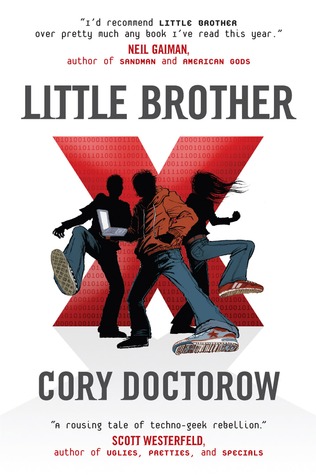
Cory Doctorow’s Little Brother is a young adult techno-thriller set in a near-future San Francisco in the aftermath of a devastating terrorist attack on the Bay Bridge. The protagonist, seventeen-year-old Marcus Yallow — a hacker and privacy advocate who goes by the handle “w1n5t0n” — is detained without charge by the Department of Homeland Security along with his friends after being caught in the wrong place at the wrong time. When he is eventually released, he finds himself living in a surveillance state: his city blanketed with sensors, his movements tracked, his peers treated as suspects. Rather than submit, Marcus uses his technical knowledge to organize a youth-driven resistance movement against the government’s overreach, building encrypted networks and teaching his generation how to fight back against an authoritarian security apparatus.
The novel wears its politics openly and unapologetically. Doctorow uses the story as a vehicle for exploring civil liberties, the tension between security and freedom, and the power of technology both to oppress and to liberate. Marcus is a deliberately idealized narrator — clever, principled, and galvanizing — and the book is frequently didactic in the best sense, pausing to explain cryptography, threat modeling, and the mechanics of surveillance with the enthusiasm of a gifted teacher. The prose is fast and accessible, aimed squarely at teenagers who have grown up online but may not yet have considered what privacy truly means or what it costs to surrender it. The title explicitly invokes Orwell’s 1984, but Doctorow’s vision is more optimistic: the kids, armed with knowledge, push back.
Key takeaways
-
Security theater vs. genuine safety: The novel argues that pervasive surveillance — facial recognition cameras, tracking cards, monitored internet traffic — creates the illusion of security while making everyone less free. Marcus demonstrates repeatedly that such systems are easily gamed by those who understand them, while honest citizens bear the cost.
-
Cryptography as self-defense: Doctorow treats encryption tools like the Onion Router (Tor) and public-key cryptography not as exotic hacker arcana but as fundamental rights and practical necessities. Marcus teaches his friends — and implicitly the reader — how to use these tools to preserve privacy.
-
The chilling effect of mass surveillance: One of the book’s most powerful arguments is that surveillance doesn’t have to punish everyone to control everyone. Knowing you might be watched changes behavior, suppresses dissent, and erodes the willingness to take risks — including the risks necessary for political resistance.
-
Institutional betrayal and the abuse of crisis: The DHS in the novel exploits the post-attack panic to expand its powers well beyond what security actually requires. Doctorow illustrates how emergency measures have a way of becoming permanent, and how institutions entrusted with protection can become the primary source of harm.
-
Youth agency and peer-to-peer organizing: Rather than waiting for adults or institutions to fix things, Marcus builds the “Xnet,” a mesh network running on repurposed Xbox consoles, giving young people a communications infrastructure the government cannot easily monitor or shut down. The novel is a sustained argument for the political power of technically literate young people.
-
The personal cost of resistance: Marcus’s activism strains his relationships with his parents, costs him a friend whose loyalty breaks under pressure, and exposes him to genuine danger and psychological trauma. Doctorow doesn’t let resistance be purely triumphant — it demands sacrifice and carries real emotional weight.
-
Transparency and accountability as counterweights: The book ultimately suggests that the answer to surveillance isn’t just privacy for individuals but transparency and accountability for institutions — a theme Doctorow has developed across much of his nonfiction work as well.