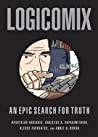
Logicomix, written by Apostolos Doxiadis and Christos Papadimitriou and illustrated by Alecos Papadatos and Annie Di Donna, is a graphic novel that tells the story of Bertrand Russell’s lifelong quest to find certain, unshakeable foundations for mathematics. Beginning with Russell as an old man addressing a crowd in 1939, the narrative weaves between his personal biography and the grand intellectual project he shared with colleagues like Alfred North Whitehead, Gottlob Frege, David Hilbert, and Ludwig Wittgenstein. The book frames the history of mathematical logic — one of the most abstract and demanding fields of human thought — as a genuinely dramatic story of obsession, ambition, and failure.
What makes Logicomix unusual among works of popular science is its self-awareness about its own storytelling. The authors and illustrators appear as characters in the book, debating how to represent Russell’s ideas and whether the narrative they are constructing is faithful to history. This meta-fictional layer allows the book to openly wrestle with the tension between dramatic simplification and intellectual honesty. The result is a work that is simultaneously a biography of Russell, an accessible introduction to the foundations of logic and mathematics, and a meditation on the relationship between reason, madness, and human ambition. The tone is warm but never condescending, treating readers as capable of engaging with difficult ideas while never losing sight of the human stakes.
The central tragedy the book chronicles is the collapse of the logicist program — the dream that all of mathematics could be derived from pure logic alone, built on a perfectly secure foundation. Russell and Whitehead spent more than a decade producing Principia Mathematica, their monumental attempt to accomplish exactly this. But the dream was ultimately undone by Kurt Gödel’s incompleteness theorems, which demonstrated that any sufficiently powerful formal system must contain truths it cannot prove. The book treats this not merely as an intellectual defeat but as something almost existentially devastating for those who had devoted their lives to the project. Woven throughout is the haunting suggestion — handled with care rather than sensationalism — that the obsessive pursuit of absolute logical certainty may itself be connected to the mental instability that shadowed Russell’s life and the lives of several figures in his orbit, including Frege, Cantor, and Wittgenstein.
Key takeaways
-
The logicist dream and its collapse: Russell and Whitehead’s Principia Mathematica represented the apex of the effort to ground all mathematics in logic, but Gödel’s incompleteness theorems showed this project was fundamentally impossible, a revelation the book treats as one of the great intellectual reversals of the twentieth century.
-
Logic and madness as intertwined themes: The book repeatedly draws attention to the number of foundational logicians — Cantor, Frege, Boltzmann, and others — who suffered mental breakdowns or descended into irrationality, suggesting a provocative if inconclusive link between the pursuit of perfect logical certainty and psychological fragility.
-
Russell as a flawed, human protagonist: Rather than hagiography, the book presents Russell honestly — as a man capable of deep moral seriousness and soaring intellect who was also cold to those closest to him, prone to romantic chaos, and at times self-deceiving about his own certainties.
-
Meta-narrative as a feature, not a bug: The authors’ decision to appear as characters debating their own narrative choices models the very problems the book is about — how do you represent truth faithfully? What must be simplified, and what is lost in the simplification? — making the form enact the content.
-
Mathematics as a human and historical activity: By embedding formal logic in biography and political history, the book insists that mathematics is not produced by disembodied minds but by people embedded in time, culture, friendship, rivalry, and grief.
-
The Greek chorus and the role of Oresteia: The book frames Russell’s story through the lens of Greek tragedy, culminating in a visit to a performance of Aeschylus’s Oresteia, suggesting that the ancient questions about justice, reason, and the limits of human understanding remain unresolved — and that logic alone was never going to resolve them.
-
Accessible gateway to foundational mathematics: Without requiring any prior mathematical knowledge, the book introduces readers to set theory, Russell’s paradox, formal systems, and Gödel’s theorems in a way that genuinely illuminates why these ideas mattered and still matter.