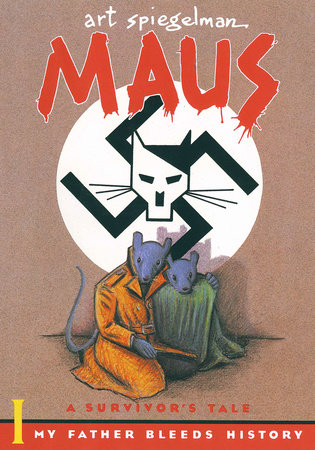
Art Spiegelman’s Maus is a graphic memoir that tells two intertwined stories: the harrowing experiences of Vladek Spiegelman, a Polish Jew, during the Holocaust, and Art’s fraught present-day relationship with his aging, difficult father as he tries to document those experiences. Originally serialized in Raw magazine before being collected into two volumes, the book depicts Jews as mice, Nazis as cats, Poles as pigs, and Americans as dogs — a visual metaphor that at once distances and intensifies the horror of its subject matter. Spiegelman renders genocide through the grammar of the funny animal comic, a form so seemingly innocent that the contrast becomes its own argument about the inadequacy and necessity of representation.
The narrative moves back and forth between the 1970s–80s, where Art visits his father in Rego Park, Queens, and the 1930s–40s, where Vladek recounts his life in Sosnowiec, Poland, through the camps, and ultimately to survival. Vladek emerges as a deeply complicated figure — resourceful, resilient, and infuriating, shaped by the war into a man who hoards string and food, manipulates those around him, and exasperates his son at nearly every turn. Art does not soften him or turn him into a symbol of noble suffering. The result is a portrait of trauma’s long tail: how survival remade a person, and how that remade person in turn shaped his son and grandson. Spiegelman’s self-reflexive meta-commentary — visible in sequences where he draws himself sitting atop a pile of mouse corpses, struggling with the weight of telling this story after the first volume’s success — makes Maus as much about the ethics of storytelling as it is about the Holocaust itself.
Key takeaways
-
The animal metaphor is political and purposeful. By casting racial and national groups as different animals, Spiegelman exposes the absurdity of racial categorization while also implicating the dehumanizing logic the Nazis themselves used. The metaphor is not a simplification but an interrogation.
-
Trauma is inherited, not just survived. Art grew up in the shadow of a Holocaust he did not experience and a brother, Richieu, who died before he was born. The book quietly argues that the second generation carries wounds that are real even if they are indirect — a theme made explicit when Art compares himself to a ghost-portrait of Richieu on his parents’ wall.
-
Vladek is portrayed without idealization. His survival depended on intelligence, luck, and connections, but Spiegelman refuses to make him saintly. His racism toward Black people, his manipulation of Art, and his obsessive frugality are presented honestly, complicating any simple reading of survivor as hero.
-
The act of telling is itself part of the story. Spiegelman breaks the frame repeatedly — showing himself as an author, depicting the death of his mother Anja (who survived the camps but later died by suicide), and grappling with how to honestly represent events he only knows secondhand. The book questions whether any account of the Holocaust can be adequate.
-
Anja’s absence haunts the entire narrative. Vladek destroyed her diaries after her suicide, an act Art calls “murder” — the erasure of her testimony, her voice, and her version of events. Her silence underscores how much of Holocaust experience remains irrecoverable.
-
The medium is inseparable from the message. Spiegelman uses the comics form not as a workaround but as a deliberate choice: the gutters between panels enact the gaps in memory and testimony, and the crude, scratchy black-and-white drawing style carries its own gravity, refusing the slickness that might aestheticize suffering.
-
Memory is unreliable and mediated. Art records Vladek on tape, and the book is technically his reconstruction of those recordings. Small moments — Vladek misremembering a song, Art admitting he’s tidied up the dialogue — remind readers that what they are reading is a version, filtered through time, grief, and the complex love between a difficult father and an ambivalent son.