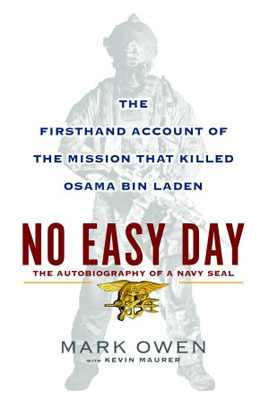
Mark Owen’s No Easy Day is a first-person account of the Navy SEAL raid that killed Osama bin Laden on May 2, 2011, written by one of the operators who was on the assault team inside Abbottabad, Pakistan that night. “Mark Owen” is a pseudonym for a decorated SEAL Team Six (DEVGRU) operator who participated in hundreds of combat missions across Afghanistan and Iraq over a career spanning more than a decade. The book was published in 2012 and caused significant controversy within the Pentagon and intelligence community, both for the operational details it revealed and for the fact that it was not submitted for the standard pre-publication security review.
The narrative moves on two tracks. The first is a tightly drawn, almost minute-by-minute reconstruction of Operation Neptune Spear — the intelligence buildup, the rehearsals at a mock compound, the long helicopter flight into Pakistan, the crash of a stealth Black Hawk, and the room-by-room clearance of the compound that ended with bin Laden dead on the top floor. The second track is a broader memoir of what it takes to reach and survive in the SEAL teams: the grinding selection pipeline, deployments to Ramadi and Kunar, and the psychological weight of losing teammates. Owen writes in a direct, unadorned style that suits his subject — he is not a literary stylist, but his credibility as an eyewitness gives even the plainest sentences considerable force. The tone is proud but not triumphalist; he is careful to distribute credit across the entire assault force and the intelligence analysts whose years of work made the mission possible.
One of the book’s most discussed revelations concerns the moment of bin Laden’s death. Owen describes bin Laden as already shot and falling — or fallen — when the lead assaulter entered the bedroom, contradicting some earlier official accounts that portrayed bin Laden as having been shot while standing upright and presenting a potential threat. Owen also pushes back gently against what he saw as an overly political media rollout of the mission, expressing frustration that the White House shaped the narrative in ways he considered inaccurate. These passages gave the book a polemical undercurrent that readers on different sides of the political spectrum interpreted very differently.
Key takeaways
-
The raid almost aborted before it began. When the stealth helicopter tail-struck the compound wall and crashed on insertion, the assault team had to improvise immediately, losing critical minutes and the element of surprise they had rehearsed around. Owen conveys how training and rehearsal — not any single moment of heroism — allowed the team to adapt without panic.
-
Bin Laden was not shot in a firefight. According to Owen’s account, the al-Qaeda leader was encountered in a doorway, already wounded or falling after being shot by the point man, and was finished on the floor. This directly contradicted initial White House and Pentagon statements suggesting he was killed in an exchange of fire while potentially reaching for a weapon.
-
SEAL selection is designed to reveal character under exhaustion. Owen devotes substantial space to BUD/S and the Green Team selection pipeline for DEVGRU, arguing that the point of the training is not to build toughness from scratch but to expose who a candidate already is when stripped of sleep, warmth, and dignity — and to see whether that person can still think and lead.
-
The cumulative weight of deployments is as dangerous as any single mission. Owen describes a culture inside the teams that valorizes going back downrange, making it socially and professionally difficult to acknowledge the psychological toll of repeated combat. He notes the loss of friends and the creeping normalization of violence without offering easy answers.
-
Intelligence work, not the assault itself, was the decisive factor. The book makes clear that years of patient analytical work by CIA and other intelligence personnel — identifying the courier, tracking him to Abbottabad, building a picture of the compound’s residents — represented the real breakthrough. The raid itself was, by SEAL standards, a relatively brief execution problem.
-
Operational security exists in tension with democratic accountability. By writing the book at all — and by bypassing prepublication review — Owen implicitly raised questions about when special operators owe the public an unmediated account and when classified details must remain secret. The book sparked a Justice Department investigation and a lasting debate inside the special operations community about these boundaries.
-
The mission brought closure but not catharsis. Owen ends on a notably muted note, describing the flight back to Jalalabad with bin Laden’s body aboard and finding that the elation he expected simply did not arrive. The sense of incompleteness — with the broader war continuing and friends already lost — gives the book’s final pages a reflective, almost melancholy quality that complicates any simple triumphalist reading.