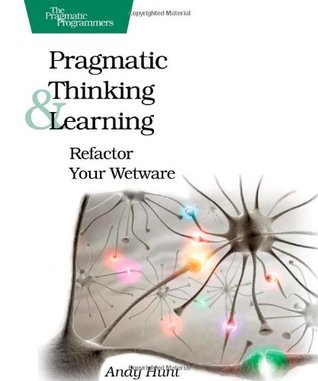
Andy Hunt’s Pragmatic Thinking and Learning is a guide for software developers — and knowledge workers more broadly — who want to become more effective at learning, problem-solving, and creative thinking. Drawing on cognitive science, neuroscience, psychology, and practical experience as a programmer and educator, Hunt argues that most professionals are never taught how to think or learn deliberately, and that rectifying this gap can dramatically accelerate skill development and day-to-day effectiveness. The book is warm, anecdote-rich, and conversational in tone, sitting somewhere between a self-help manual and a technical primer on the science of the mind.
A central organizing metaphor throughout the book is the Dreyfus model of skill acquisition, which Hunt uses to frame how people progress from novice to expert in any domain. Novices rely on rules and step-by-step instructions; experts operate largely on intuition, pattern recognition, and holistic understanding. Hunt stresses that the strategies that help a novice are often actively harmful for an expert, and vice versa — a mismatch that causes widespread frustration in education and mentorship. He extends this framework into a broad exploration of how the brain works in practice: the interplay between analytical, linear thinking (which he loosely associates with “L-mode,” or left-brain-style processing) and the holistic, intuitive, pattern-matching thinking of “R-mode.” Rather than privileging one over the other, Hunt argues that productive thinking requires deliberately engaging both modes, and that most professional environments systematically suppress the R-mode at great cost.
The practical bulk of the book offers techniques for managing attention, harvesting intuition, building better habits, and designing an environment that supports learning. Hunt recommends practices like keeping a personal wiki or notebook, morning pages (freewriting upon waking), mind maps, and deliberate practice structured around feedback. He is candid about cognitive biases — the anchoring effect, confirmation bias, and others — that derail even experienced thinkers, and advocates for cultivating an awareness of one’s own mental shortcuts. Throughout, Hunt’s voice is that of a seasoned pragmatist: skeptical of silver bullets, enthusiastic about experimentation, and insistent that small, consistent changes to how you work and think compound into dramatic long-term improvements.
Key takeaways
-
The Dreyfus model reframes skill and teaching. Skill acquisition moves through five stages — novice, advanced beginner, competent, proficient, expert — and what works at each stage differs sharply. Experts need autonomy and context; novices need rules and safety. Treating everyone the same undermines both groups.
-
R-mode thinking is an underutilized resource. Intuition, creativity, and pattern recognition happen largely outside conscious awareness. Techniques like freewriting, sketching, and mind-mapping can surface R-mode insights that purely analytical, step-by-step thinking misses.
-
You must actively harvest your intuitions. The brain solves problems in the background, but these solutions evaporate quickly if not captured. Hunt recommends always having a way to record ideas — notebooks, voice recorders, index cards — and treating the capture habit as non-negotiable.
-
Cognitive biases silently distort judgment. Professionals are just as susceptible to confirmation bias, anchoring, and the fundamental attribution error as anyone else. Recognizing these traps is the first step toward mitigating them, and deliberate reflection (journaling, retrospectives) helps expose blind spots.
-
Context and environment shape cognition powerfully. The physical and social environment you work in either supports or sabotages clear thinking. Constant interruptions, open-plan noise, and notification culture fragment attention and make deep, creative work nearly impossible.
-
Learning requires deliberate practice with feedback. Passive reading or experience alone does not build expertise. Hunt champions structured practice, personal projects that push beyond comfort zones, and tight feedback loops — the same principles found in research on expert performance.
-
Personal knowledge management is a professional responsibility. Maintaining a personal wiki, reading actively, and building a coherent external system for notes and ideas extends the brain’s capacity and transforms scattered information into accessible, connected knowledge over time.