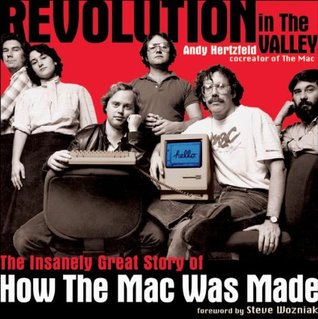
Andy Hertzfeld’s Revolution in the Valley is a firsthand account of the creation of the original Apple Macintosh computer, told by one of the core engineers who built it. Hertzfeld was a member of the small, intensely driven team that worked under Steve Jobs in the early 1980s to produce what they believed would be a transformative personal computer — one that would bring a graphical user interface and genuine ease of use to the masses. The book is drawn from Hertzfeld’s website folklore.org, where he had been publishing his recollections for years, and it reads like a collection of vivid, self-contained anecdotes rather than a linear narrative. Each story illuminates a particular moment, personality clash, engineering challenge, or stroke of inspiration from the Mac’s development between roughly 1979 and 1984.
The book captures the peculiar culture of the Macintosh project with warmth and honesty. Hertzfeld portrays a team of brilliant, eccentric individuals working impossibly long hours, driven by a genuine belief that they were doing something historically significant. Steve Jobs looms large throughout — mercurial, demanding, inspiring, and frequently infuriating. Hertzfeld neither hagiographizes nor dismisses him; Jobs emerges as a complex force of nature whose distortion of reality could be both maddening and genuinely motivating. Other figures — Burrell Smith, Bill Atkinson, Joanna Hoffman, Susan Kare — are rendered with equal affection and specificity, giving the book the texture of a group portrait rather than a great-man narrative. Hertzfeld’s voice is that of an enthusiastic engineer who still marvels at what they pulled off, and his technical explanations are clear enough for general readers without being dumbed down.
Key Takeaways
-
The Mac was built by a tiny, missionary team. Fewer than thirty core people created the original Macintosh, working in a building deliberately separated from the rest of Apple. Jobs cultivated a pirate mentality — the team had their own flag, their own culture, and a fierce sense that they were the best engineers in the world doing the most important work imaginable.
-
Steve Jobs’s “reality distortion field” was a genuine phenomenon. Hertzfeld coins and illustrates this phrase throughout the book: Jobs could convince people that impossible deadlines were achievable, that features requiring months could be done in days, and that compromises were unacceptable — and somehow the team would deliver. The effect was real even when everyone knew what he was doing.
-
Susan Kare’s design work was foundational. The icons, typefaces, and visual language Kare created for the Mac — the smiling Mac face, the trash can, the Chicago font — gave the machine its personality and were every bit as important as the underlying code. Hertzfeld treats her contributions with the same seriousness as the engineering feats.
-
Hardware and software had to co-evolve under severe constraints. The Mac shipped with 128K of RAM, a limitation that forced constant, creative optimization. Burrell Smith’s hardware designs and the software team’s coding were in constant dialogue, with changes in one domain rippling immediately into the other. The constraints, paradoxically, drove ingenuity.
-
Competition and tension with the Lisa team shaped the Mac. Apple’s more expensive Lisa computer, which pioneered many of the GUI concepts the Mac would popularize, was developed in parallel, and the relationship between the two teams was fraught. The Mac team borrowed ideas, raided talent, and ultimately produced a cheaper, faster machine that overshadowed Lisa entirely.
-
The launch moment was as dramatic as the development. The January 1984 introduction of the Macintosh — the famous “1984” Super Bowl ad, Jobs’s theatrical unveiling, the Mac speaking its own name aloud — was a culmination the team experienced with euphoria and exhaustion in equal measure. Hertzfeld conveys how surreal it felt to watch the world react to something they had lived inside for years.
-
Personal relationships and human drama were inseparable from the technology. The book is as much about friendships, rivalries, romances, and heartbreaks as it is about software. People quit in anger, were fired unjustly, fell in love, and sacrificed personal lives for the project. Hertzfeld’s willingness to include this messiness makes Revolution in the Valley far more honest than most technology histories.