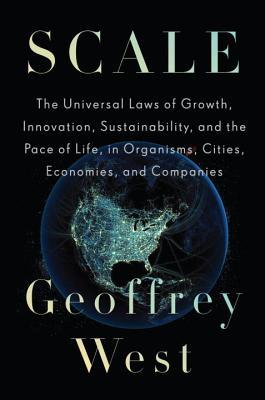
Geoffrey West’s Scale is a sweeping investigation into the hidden mathematical laws that govern the size and growth of living organisms, cities, and companies. West, a theoretical physicist who spent decades at the Santa Fe Institute, argues that beneath the apparent complexity and diversity of the natural and human world lies a surprisingly small set of universal scaling principles. These principles — often expressed as simple power laws — predict everything from how fast a heart beats to how quickly a city’s economy grows as its population doubles. The book is ambitious in the best sense: it draws connections across biology, urban planning, economics, and corporate life, using the tools of physics to find order in domains that typically resist quantitative unification.
At the heart of the book is the concept of allometric scaling — the observation that many biological properties scale not linearly but as fractional powers of body mass. A whale’s heart doesn’t beat proportionally more slowly than a mouse’s; the relationship follows a precise mathematical curve. West and his collaborators helped discover that metabolic rate scales as the three-quarters power of body mass across virtually all living things, a finding that ripples outward to explain why larger animals live longer, grow more slowly, and are in a deep sense more energy-efficient. The underlying mechanism, West argues, is the fractal geometry of distribution networks — blood vessels, bronchial trees, plant vascular systems — which evolution has optimized under universal physical constraints. The writing is accessible but never dumbed down; West’s voice is that of a scientist genuinely astonished by what the numbers reveal, and he handles both the wonder and the rigor with equal enthusiasm.
The book’s second half turns from biology to human constructions, and here West’s argument becomes particularly provocative. Cities, he finds, also obey scaling laws — but with a crucial difference. Biological scaling is sublinear, meaning larger organisms are more efficient but grow more slowly and ultimately die. Cities, by contrast, show superlinear scaling in measures of innovation, wealth creation, and social interaction: doubling a city’s population more than doubles its patents filed, restaurants opened, and wages earned. This suggests cities are fundamentally different kinds of networks from organisms — open, accelerating, and potentially immortal. Companies, intriguingly, turn out to behave more like organisms than cities: they grow quickly, plateau, and almost inevitably die. The juxtaposition of these three systems — bodies, cities, companies — forms the intellectual spine of the book and raises urgent questions about sustainability, growth, and the long-term future of human civilization.
Key takeaways
-
The three-quarters scaling law: Metabolic rate across living organisms scales as body mass to the power of 0.75, not 1.0 — meaning larger animals are systematically more energy-efficient per unit mass, a relationship explained by the fractal geometry of internal distribution networks.
-
Fractals as the engine of biology: The branching architecture of circulatory, respiratory, and vascular systems has been optimized by evolution to minimize energy loss and maximize reach. This fractal structure is the physical origin of most biological scaling laws, from lifespan to growth rate to the number of heartbeats in a lifetime (roughly constant across species at around 1.5 billion).
-
Cities superscale: Unlike organisms, cities show superlinear returns — doubling population produces more than double the innovation, income, and cultural output. This makes cities engines of open-ended growth and the primary reason human civilization has continued to accelerate.
-
Companies behave like organisms, not cities: Despite their urban origins, corporations scale sublinearly as they grow, becoming less innovative per employee over time. They tend to plateau and die on timescales that can be mathematically predicted, more like biological organisms subject to entropy than like self-renewing cities.
-
The accelerating treadmill of innovation: Because cities and economies grow superlinearly, each successive cycle of innovation must arrive faster than the last to sustain growth and prevent collapse. West calls this the “major cycles of innovation” problem — humanity is on a treadmill that keeps speeding up, with no obvious way to step off.
-
A unified science of scale: West’s larger ambition is to demonstrate that a quantitative, predictive science of cities, companies, and social systems is possible — that the complexity of human life is not immune to the kind of mathematical order that physics finds in the natural world, and that big data combined with scaling theory could yield a genuine “science of cities.”