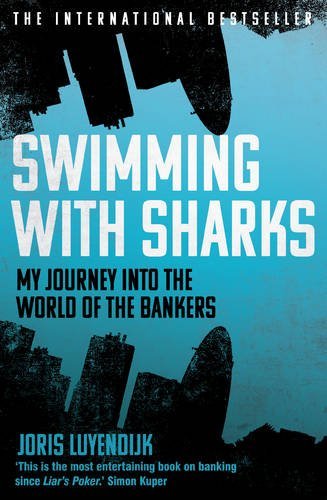
Joris Luyendijk, a Dutch journalist and anthropologist by training, spent several years embedded in the City of London’s financial district, conducting hundreds of anonymous interviews with bankers, traders, risk managers, compliance officers, and support staff. Swimming With Sharks — published in the UK as a companion to his Guardian “banking blog” — is the result of that immersion. Luyendijk arrives as a deliberate outsider, someone who freely admits he knew almost nothing about finance before he began, and he uses that naivety as a methodological tool, asking the obvious questions that insiders have long stopped asking. The book is less a polished argument than a reported journey, and its cumulative effect is quietly devastating.
The central revelation Luyendijk builds toward is not that the financial sector is full of villains, but that it is full of ordinary people operating inside a system whose incentives, structures, and cultural norms make catastrophic risk-taking not just possible but rational — and in many cases inevitable. He finds that most bankers are neither monsters nor ideological zealots. They are workers on short-term contracts, worried about their bonuses and their mortgages, disconnected from the ultimate consequences of the products they sell or the bets they place. This structural analysis, drawn out through dozens of quietly revelatory conversations, is more unsettling than any portrait of greed could be, because it suggests the problem cannot be solved simply by replacing bad actors with good ones.
Key takeaways
-
Fear, not greed, may be the dominant emotion in banking. Many of Luyendijk’s interviewees describe a culture of pervasive insecurity — zero-hour-style contract norms, sudden layoffs, and the constant threat of being “managed out” — which creates short-termism and moral disengagement rather than brazen risk-hunger.
-
The “conveyor belt” problem makes accountability nearly impossible. Because employees rotate through roles, move between firms, and exit before consequences materialize, no single person feels responsible for the products or trades that cause harm. Systemic failure becomes genuinely orphaned.
-
Most people in finance do not understand what colleagues in other divisions do. The industry is so siloed and specialized that a trader may have no idea what a structurer in the next department is constructing, let alone how it will behave in a crisis. This opacity is not merely a communications failure — it is baked into the architecture.
-
The concept of “sociopaths at the top” is too simple. Luyendijk profiles senior figures and finds that many are charming, intelligent, and even self-aware about the system’s flaws. The problem is not individual pathology but a tournament culture that selects for a particular kind of ruthlessness while making those who reach the top genuinely believe their rewards are deserved.
-
Regulation is hampered by regulatory capture and the revolving door. The same expertise required to understand complex financial products exists almost exclusively inside the banks themselves, meaning regulators are perpetually outgunned and often looking to the industry for both guidance and future employment.
-
The 2008 crisis changed the culture far less than outsiders assumed. Many interviewees describe a brief period of genuine fear followed by a fairly rapid return to business as usual, aided by bailouts that confirmed the implicit guarantee and removed the existential pressure that might have forced structural change.
-
An anthropological lens reveals finance as a culture, not just a sector. By treating bankers as a tribe with its own rituals, taboos, language, and status hierarchies, Luyendijk makes the industry legible in human terms — and in doing so, makes its dangers feel more tractable, because cultures can, in principle, be changed.