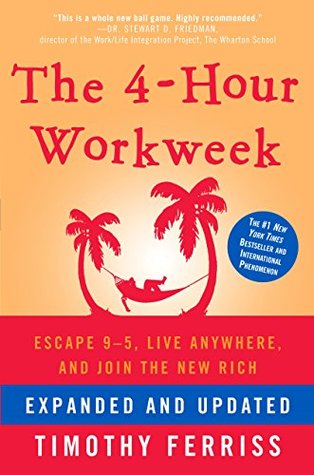
Timothy Ferriss’s The 4-Hour Workweek is a provocative self-help and lifestyle design manual that challenges the conventional model of deferring life’s pleasures until retirement. Ferriss argues that the traditional path — work hard for decades, save diligently, and enjoy freedom only in old age — is both inefficient and unnecessary. Instead, he proposes that with the right systems, automation, and mindset shifts, anyone can escape the nine-to-five grind and design what he calls the “New Rich” lifestyle: one defined not by accumulated wealth but by time, mobility, and experiences enjoyed in the present.
The book is organized around Ferriss’s DEAL framework — Definition, Elimination, Automation, and Liberation. He begins by encouraging readers to redefine their goals and fears, using exercises like “fear-setting” to clarify what they actually want versus what they’ve been conditioned to pursue. He then advocates ruthlessly eliminating low-value tasks and distractions, drawing heavily on the Pareto principle (the idea that 80% of results come from 20% of efforts). Automation involves outsourcing work — including personal tasks — to virtual assistants and building businesses that generate passive income with minimal ongoing involvement. Liberation, the final step, addresses how to negotiate remote work arrangements or escape an unfulfilling job entirely. Ferriss writes in a breezy, irreverent tone, mixing personal anecdotes, concrete how-to instructions, and a salesman’s enthusiasm that some readers find energizing and others find glib.
Key takeaways
-
Reframe retirement as a flawed goal. Ferriss argues that saving everything for a retirement decades away is a poor trade. The “New Rich” take frequent “mini-retirements” throughout their lives rather than deferring all leisure to old age.
-
Fear-setting over goal-setting. One of the book’s most practical exercises asks readers to define their worst-case scenarios in detail, assess how likely and recoverable they are, and recognize that inaction is often riskier than the leap they’re afraid to take.
-
The 80/20 principle applied ruthlessly. Ferriss urges readers to identify which 20% of clients, tasks, or activities produce 80% of their desired results — and then eliminate, delegate, or ignore the rest without guilt.
-
Batching and information diets. Rather than checking email constantly, Ferriss recommends processing it only once or twice a day and going on a strict “low-information diet,” avoiding news and other inputs that create busyness without value.
-
Outsourcing your life. The book popularized the idea of hiring overseas virtual assistants for surprisingly low hourly rates to handle everything from research and scheduling to personal errands, freeing up mental bandwidth for higher-leverage work.
-
Building a “muse.” Ferriss’s term for a small, automated online business — ideally selling a niche product or information good — that generates enough passive income to fund a modest but adventurous lifestyle without requiring the owner’s constant attention.
-
Relative vs. absolute wealth. A core insight is that a modest income goes much further in cheaper countries or lower-cost environments, meaning geographic arbitrage can effectively multiply purchasing power and make a “rich” lifestyle accessible far sooner than conventional financial planning suggests.