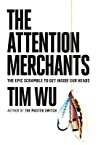
Tim Wu’s The Attention Merchants is a sweeping historical account of how human attention became the most coveted commodity in the modern economy. Wu traces the rise of what he calls the “attention merchants” — businesses whose revenue model depends on capturing mass human attention and reselling it to advertisers — from the early days of penny newspapers in the 1830s through the rise of social media platforms in the twenty-first century. The book is both a cultural history and a cautionary argument, contending that the industrialization of attention has reshaped society, politics, and private life in ways most people never consciously chose and rarely stop to examine.
Wu writes with a journalist’s flair for narrative and a legal scholar’s eye for systemic critique, moving briskly through episodes that range from the birth of advertising-supported newspapers and the propaganda campaigns of World War I to the golden age of broadcast television, the dot-com boom, and the smartphone era. Along the way he profiles the inventors, entrepreneurs, and hucksters who discovered that attention, once harvested at scale, could be monetized almost without limit. He also documents the recurring cycles of public backlash — what he calls “revolts” — in which audiences grow weary of manipulation and demand something more authentic, only for new attention merchants to adapt and recapture them with fresher techniques. The tone is engaged and occasionally wry, written for a general reader rather than an academic audience, though the underlying argument is serious and sustained.
The book’s deepest concern is what the relentless competition for attention does to individuals and to democratic culture. Wu worries that when every waking moment is colonized by commercial stimulation, the capacity for reflection, depth, and genuine self-determination erodes. He invokes thinkers like William James on the centrality of attention to a meaningful life, and draws on historical figures from P.T. Barnum to Mark Zuckerberg to show that the logic of the attention trade has remained remarkably consistent even as its technologies have multiplied. His implicit prescription is not a Luddite rejection of media but a call for greater awareness — and perhaps collective action — to reclaim sovereignty over one’s own mind.
Key takeaways
-
Attention as an economic resource. Wu’s central insight is that attention merchants do not really sell products or even media — they sell audiences to advertisers. Human attention is the raw material extracted, refined, and traded, making the business fundamentally extractive rather than simply commercial.
-
The penny press invented the model. The modern attention economy traces back to Benjamin Day’s New York Sun in 1833, which sold newspapers below cost to build a mass readership and then monetized that readership through advertising — a template every subsequent medium has essentially replicated.
-
Propaganda proved attention could move masses. World War I demonstrated, on both sides, that attention harvested through media could be weaponized to reshape public opinion and behavior at a national scale, giving governments and later corporations a playbook for mass persuasion.
-
Recurring cycles of capture and revolt. Throughout history, audiences eventually resist the most intrusive or manipulative forms of attention harvesting — turning away from sensationalist tabloids, muting commercials, installing ad blockers — but merchants consistently find new platforms and subtler methods to re-engage them.
-
Television’s Faustian bargain. Broadcast television perfected the trade by delivering free entertainment in exchange for exposure to advertising, normalizing the idea that attention itself was adequate payment — a bargain audiences accepted without fully understanding what they were surrendering.
-
The internet intensified the extraction. Online platforms, especially social media, collapsed the boundary between content and advertising, used behavioral data to micro-target individuals, and designed interfaces to maximize time-on-site, making the attention economy more total and more personal than any previous incarnation.
-
The stakes are existential for selfhood and democracy. Drawing on William James’s view that a life is defined by what one chooses to attend to, Wu argues that surrendering control of attention to commercial interests is not a trivial inconvenience but a genuine threat to autonomous identity, meaningful leisure, and an informed citizenry capable of self-governance.