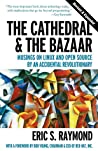
Eric S. Raymond’s The Cathedral and the Bazaar is an extended essay — later expanded into a collection — that examines the culture, economics, and surprising effectiveness of open-source software development. Drawing on his own experience releasing and maintaining the email-fetching utility fetchmail, Raymond contrasts two fundamental models of software construction: the “cathedral,” in which code is crafted carefully by a small group of developers working in relative isolation toward periodic releases, and the “bazaar,” in which code is developed in the open, with contributions welcomed from a wide and loose community of participants. The central argument is that the bazaar model, long dismissed as chaotic, actually produces robust, high-quality software — and that Linus Torvalds’s development of the Linux kernel proved this on a historic scale.
Raymond writes as a participant-observer and self-described hacker, and his voice is enthusiastic, occasionally polemical, and packed with aphorisms that have since entered the vocabulary of software culture. He is not writing academic computer science but something closer to a manifesto combined with empirical reflection: he notices patterns in how successful open-source projects evolve, codifies them into rules of thumb, and tests those rules against his own project’s history. The result is a book that operates simultaneously as a how-to guide, a sociological account of a community, and an argument about what motivates programmers and why gifts and reputation can outcompete salary and hierarchy as incentives for creative technical work.
Beyond the cathedral-and-bazaar metaphor itself, Raymond extends his analysis into related essays that take up the anthropology of hacker culture, the gift economy that underlies open-source contribution, and the strategic question of how and why companies might benefit from releasing code. He draws on ideas from economics and evolutionary biology to explain why “many eyes make all bugs shallow” — a principle he names Linus’s Law — and why the cost of peer review in a distributed community can be far lower than the cost of internal quality assurance in a closed development shop. The book is very much a product of its late-1990s moment, written in the glow of Linux’s rise and the early commercial embrace of open source by companies like Netscape, but its core observations about distributed collaboration, transparency, and intrinsic motivation have proven durable well beyond that moment.
Key takeaways
-
The cathedral vs. the bazaar: These two metaphors capture opposing philosophies of software development — closed, planned, top-down construction versus open, iterative, community-driven development. Raymond argues the bazaar consistently outperforms the cathedral for complex, widely used software.
-
Linus’s Law: “Given enough eyeballs, all bugs are shallow.” When source code is open and the user base is large and technically engaged, defects are found and fixed far faster than in closed development environments where only a small team reviews the code.
-
Release early, release often: One of Raymond’s core maxims, derived from watching Linux and confirmed by his own
fetchmailproject. Frequent releases keep users engaged, surface bugs quickly, and create a feedback loop that drives rapid improvement — the opposite of the cathedral model’s long, careful development cycles. -
The hacker gift economy: Open-source contribution is not irrational altruism but a functioning gift economy in which reputation is the currency. Programmers contribute because doing so raises their status among peers, and this system generates collective goods that market incentives alone would likely undersupply.
-
Users as co-developers: Treating users as partners rather than passive consumers is both an ethical stance and a practical strategy. Raymond finds that his most valuable bug reports and feature ideas came from users, and that welcoming their involvement transformed
fetchmailinto something better than he could have built alone. -
The importance of “scratching your own itch”: The best open-source projects tend to start because a developer genuinely needs a tool that doesn’t yet exist. Personal investment in the problem drives the sustained energy required to see a project through, and authenticity of motivation is legible to potential contributors.
-
Commercial open source is not a contradiction: The later essays address how companies can release code as open source without surrendering competitive advantage, arguing that most software value lies in services, support, and integration rather than in secrecy around source code itself — a framing that anticipated the business models of many successful technology companies.