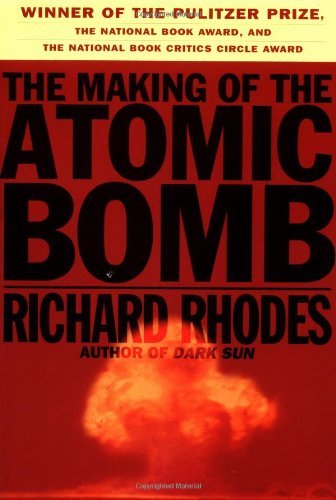
Richard Rhodes’s The Making of the Atomic Bomb is a sweeping, Pulitzer Prize–winning account of the scientific, political, and human forces that converged to produce the most destructive weapon in history. Published in 1986, the book traces the story from the earliest discoveries in nuclear physics at the turn of the twentieth century through the bombings of Hiroshima and Nagasaki in August 1945. Rhodes writes with the narrative propulsion of a novelist and the rigor of a historian, drawing on interviews, declassified documents, diaries, and memoirs to reconstruct the world in granular, often intimate detail. The result is less a triumphalist account of American ingenuity than a deeply human chronicle of how brilliant, flawed, and often morally conflicted individuals remade the world.
The book’s first third is devoted largely to the European scientific community of the 1910s, 1920s, and 1930s — the Bohrs, Rutherfords, Fermis, and Szilárds who mapped the atom’s interior and slowly grasped its terrifying energy potential. Rhodes portrays this world with genuine warmth, capturing the collaborative spirit and almost playful intellectual culture that flourished even as fascism dismantled it. The flight of Jewish and dissident scientists from Nazi Germany and occupied Europe is treated not merely as geopolitical backdrop but as a biographical tragedy, one that paradoxically redirected Europe’s finest minds toward the United States and into the arms of the Manhattan Project. By the time Rhodes turns to Los Alamos and the industrial-scale effort centered on Oak Ridge and Hanford, the reader understands the bomb not as a sudden American invention but as the culmination of half a century of international science conducted in a spirit that the weapon itself would ultimately betray.
Key takeaways
-
The bomb was a product of refugee science. Many of the project’s key figures — Leo Szilárd, Enrico Fermi, Hans Bethe, Edward Teller, and others — were European émigrés driven out by fascism. Without Hitler’s persecution of Jews and political dissidents, the talent that built the bomb would likely never have concentrated in the United States.
-
The chain reaction was foreseen before it was demonstrated. Leo Szilárd conceived of the nuclear chain reaction in 1933, almost a decade before Fermi achieved it beneath the University of Chicago’s Stagg Field in December 1942. Rhodes shows how the bomb was imagined in theory long before the physics, engineering, or politics caught up to it.
-
Los Alamos was an extraordinary and bizarre community. J. Robert Oppenheimer recruited a generation of the world’s best physicists to a remote New Mexico mesa and welded them into a functioning laboratory-city. Rhodes conveys the strange domesticity of that world — families, parties, hikes — coexisting with work whose implications everyone understood and few could fully confront.
-
The decision to use the bomb was shaped by momentum as much as deliberate choice. Rhodes makes clear that by mid-1945 the Manhattan Project had acquired a bureaucratic and military logic that made use of the weapon feel almost inevitable. The question of whether to drop it was rarely examined from first principles; the real decisions had been made incrementally over years of planning and production.
-
The bombings of Hiroshima and Nagasaki are described with unflinching specificity. Rhodes does not allow the reader to remain at a comfortable historical distance. Drawing on survivor testimony and medical records, he renders the physical and human consequences of both bombs in detail that is harrowing and deliberate — a moral counterweight to the engineering achievement the earlier chapters celebrate.
-
The scientists’ moral reckoning was real but insufficient. Many physicists — Szilárd most vocally — tried to stop or constrain the weapon’s use once Germany surrendered. The Franck Report urged a demonstration rather than a city strike. Rhodes treats these efforts seriously but shows how thoroughly they were sidelined by military and political authority, raising lasting questions about the responsibility of scientists to the technologies they create.
-
The book argues implicitly for nuclear awareness over nuclear comfort. Rhodes never editorializes crudely, but the cumulative weight of the narrative — from the beauty of early quantum physics to the charred ruins of two cities — constitutes a sustained argument that nuclear weapons demand continuous moral and political vigilance, not normalization.