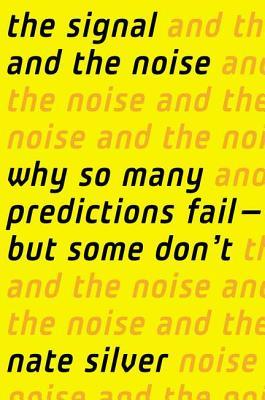
Nate Silver’s The Signal and the Noise is a sweeping examination of prediction — why some forecasters succeed while most fail, and what separates meaningful information from the statistical static that surrounds it. Drawing on his background as a baseball analyst and political forecaster, Silver takes readers through a wide range of fields where prediction matters: elections, baseball, weather, earthquakes, economics, chess, poker, climate change, and more. His central argument is that in an era of exploding data, we are not automatically becoming better at understanding the world. More data can mean more noise, and without the right frameworks for thinking probabilistically, it can lead us further from the truth rather than closer to it.
The book is structured as a series of case studies, each using a domain to illuminate a broader principle. Silver contrasts fields that have made genuine forecasting progress — meteorology, for instance, where decades of investment in models and honest feedback loops have produced meaningful improvements — with fields that have largely failed, such as macroeconomic forecasting, where overconfidence and incentive structures conspire against accuracy. His prose is accessible and enthusiastic, blending data journalism with storytelling, and he writes with the sensibility of someone who has won and lost real money on his predictions and takes the intellectual stakes personally.
Running through the book is Silver’s advocacy for Bayesian reasoning: updating beliefs incrementally as new evidence arrives rather than treating any forecast as final. He is critical of what he calls “foxes versus hedgehogs,” borrowing Isaiah Berlin’s distinction — where hedgehogs know one big thing and overfit their worldview to it, while foxes draw on many sources and hold their predictions loosely. The most accurate forecasters across nearly every domain, Silver argues, tend to be foxes: humble about uncertainty, explicit about probability, and willing to be wrong.
Key takeaways
-
Signal versus noise: The core challenge of prediction is identifying the small amount of meaningful information buried within enormous quantities of irrelevant or misleading data. More data does not automatically improve forecasts; disciplined filtering does.
-
Bayesian updating is the gold standard: Rather than seeking singular right answers, good forecasters continuously revise probability estimates as new evidence arrives. Silver argues that this probabilistic humility is the defining trait of accurate prediction across fields.
-
Foxes outpredict hedgehogs: Forecasters who draw on multiple frameworks and resist overcommitting to a single explanatory theory consistently outperform confident specialists who have one grand model of the world. Intellectual flexibility beats ideological coherence.
-
Feedback loops matter enormously: Meteorology has improved because forecasters receive rapid, clear feedback on whether they were right. Fields like economics and political punditry often lack honest accountability structures, which allows overconfidence and poor models to persist indefinitely.
-
Overconfidence is the most common forecasting sin: Across nearly every case study, Silver finds that experts systematically underestimate uncertainty. Expressing predictions as probability ranges rather than point estimates is more honest and, ultimately, more useful.
-
Models are maps, not territories: Every predictive model encodes assumptions that may be wrong. The 2008 financial crisis, Silver argues, was in large part a failure of models that treated unprecedented events as impossible simply because they hadn’t happened before — a catastrophic confusion of absence of evidence with evidence of absence.
-
Poker as a microcosm of prediction: Silver uses his experience as a semiprofessional poker player to illustrate how skill and chance interact over time. Poker rewards those who think in probabilities and make good decisions even when outcomes are bad — a mindset transferable to any domain involving uncertainty.