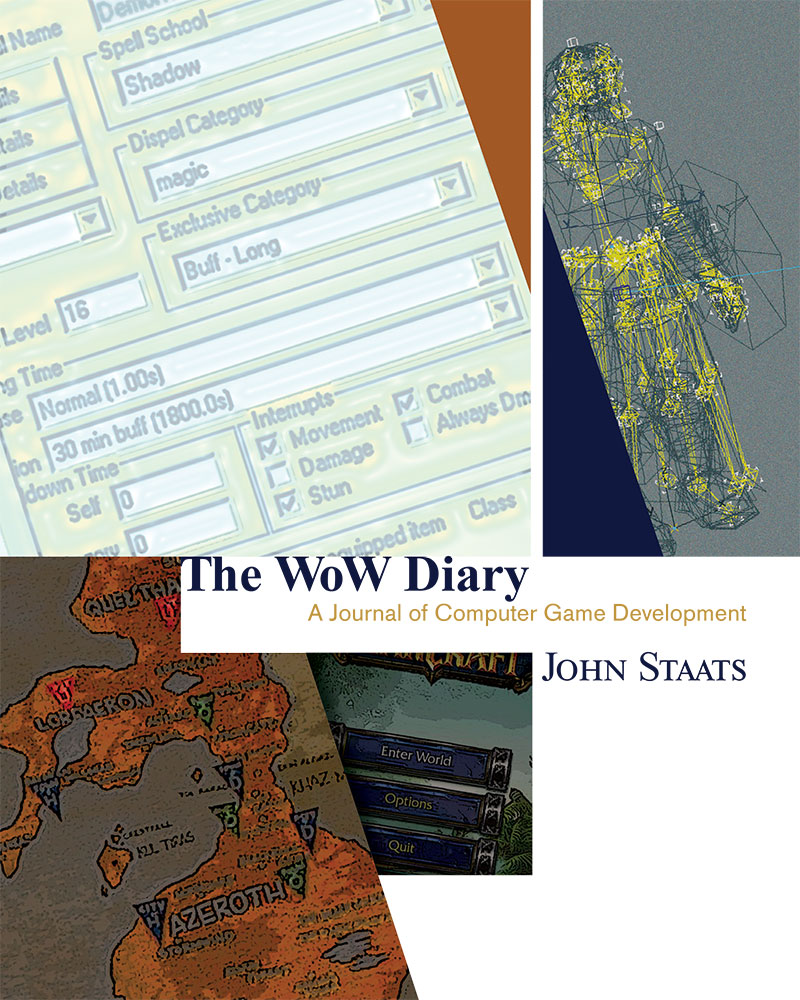
John Staats worked as the first full-time level designer at Blizzard Entertainment, and The WoW Diary is his firsthand account of the five-year development of World of Warcraft, one of the most influential and commercially successful video games ever made. Written in the style of a personal journal and memoir, the book covers the period from Blizzard’s early internal debates about whether to even build an MMO through the game’s chaotic but triumphant launch in November 2004. Staats was responsible for designing many of the game’s iconic dungeon spaces — including Blackrock Depths, Zul’Gurub, and large portions of the original world — giving him a ground-level perspective on the creative, technical, and human challenges that shaped the project.
The tone is warm, candid, and deeply personal. Staats writes with obvious affection for his colleagues and for the craft of game design, but he doesn’t shy away from the exhaustion, uncertainty, and internal friction that marked the development process. The book reads as both a love letter to a formative era in gaming and an honest document of what it actually feels like to build something enormous under enormous pressure. It is aimed squarely at fans of the game and those curious about game development, and it rewards both audiences with a level of operational detail rarely found in industry memoirs.
Key takeaways
-
WoW was not a sure thing internally. Blizzard debated seriously whether to enter the MMO market at all, and the early team operated with significant uncertainty about whether the project would survive, receive adequate resources, or ever ship. The confidence the finished product projects was hard-won, not assumed.
-
Dungeon design was an iterative, almost sculptural process. Staats describes building levels using Blizzard’s internal tools in ways that were improvisational and hands-on — designers would literally shape terrain and place encounters by feel, iterating constantly based on playtesting feedback. Iconic spaces like Blackrock Depths grew organically rather than from rigid top-down blueprints.
-
The team was small for a very long time. For most of development, the core group working on WoW was surprisingly compact, which meant individuals carried enormous responsibilities and wore multiple hats. This created both tight camaraderie and intense burnout as the launch date approached.
-
Launch was a near-disaster. The game’s explosive popularity — far beyond what Blizzard had planned for — meant servers buckled almost immediately. The team scrambled under extreme conditions to keep the game running, and the experience was as stressful as it was validating.
-
Blizzard’s culture of quality was real but costly. The company’s famous willingness to delay and revise until things felt right was not just a PR narrative — it was lived daily on the team. But that standard extracted a significant personal toll from developers, many of whom worked punishing hours for years.
-
World-building decisions made under pressure became permanent lore. Many of the design choices that players now regard as foundational — zone layouts, dungeon logic, faction geography — were made quickly, sometimes arbitrarily, and then locked in as the world expanded around them. The book gives a fascinating glimpse into how canonical “facts” of a fictional universe can be essentially accidental.
-
The book is a document of a vanishing era in game development. The mid-to-late 1990s and early 2000s represented a particular moment when small teams could still build world-defining games, when personal relationships shaped design philosophy, and when the industry had not yet fully industrialized. Staats is conscious that he is preserving something that no longer quite exists.