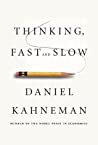
Daniel Kahneman’s Thinking, Fast and Slow is a sweeping synthesis of decades of research in cognitive psychology and behavioral economics, distilled into an accessible and often surprising account of how the human mind works. At its core, the book argues that we are not the rational agents classical economics long assumed us to be. Instead, our judgments and decisions are shaped by two distinct modes of thinking: System 1, which operates automatically, quickly, and largely below conscious awareness, and System 2, which is deliberate, effortful, and slow. Much of the book is devoted to showing how System 1’s speed and efficiency come at a cost — it is prone to systematic errors, biases, and illusions that System 2 often fails to catch because it is lazy by nature and tends to accept whatever System 1 serves up.
Kahneman draws heavily on his long collaboration with the late Amos Tversky, and the book reads in part as an intellectual memoir of that partnership. Together, they developed prospect theory and identified a catalogue of cognitive biases — anchoring, availability, representativeness, overconfidence, and many others — that have become foundational concepts in psychology and economics. The tone is warm, precise, and occasionally self-deprecating; Kahneman is candid about the fact that even he, after a career studying cognitive illusions, remains susceptible to them. The final sections broaden the inquiry into questions of happiness and well-being, distinguishing between the “experiencing self” that lives through moments and the “remembering self” that narrates our lives — a distinction with profound implications for how we measure and pursue a good life.
Key takeaways
-
System 1 and System 2: Human cognition operates through two systems. System 1 is fast, intuitive, and automatic; System 2 is slow, deliberate, and rational. Most of our daily thinking is driven by System 1, which is efficient but error-prone, while System 2 is often too passive to override it.
-
Cognitive biases are systematic, not random: Errors in judgment are not mere noise — they follow predictable patterns. Anchoring (over-relying on the first number encountered), availability bias (judging likelihood by how easily examples come to mind), and the halo effect (letting one positive trait color all other judgments) are among the most pervasive and consequential.
-
Prospect theory overturns expected utility: People do not evaluate outcomes in absolute terms but relative to a reference point, and they feel losses roughly twice as acutely as equivalent gains. This “loss aversion” explains a wide range of irrational behaviors, from investor reluctance to sell losing stocks to the power of framing effects in negotiation and policy.
-
Overconfidence is pervasive and costly: Individuals — and experts in particular — consistently overestimate their ability to predict the future and explain the past. The “planning fallacy” leads us to underestimate the time, cost, and risk of projects, while hindsight bias makes past events seem far more predictable than they were, breeding unwarranted confidence in our forecasting abilities.
-
The experiencing self vs. the remembering self: We have two distinct selves with different interests. The experiencing self registers moment-to-moment happiness, while the remembering self constructs a narrative based on peaks and endings (the “peak-end rule”). Because we make decisions based on memories rather than live experience, we often choose in ways that serve our remembered story at the expense of our actual well-being.
-
Priming and the “cognitive ease” effect: The mind is far more susceptible to contextual influence than we realize. Subtle cues — words, images, physical sensations — can prime behavior and judgment without conscious awareness. When information feels easy to process, we are more likely to accept it as true, a phenomenon with serious implications for advertising, propaganda, and public communication.
-
Statistical thinking does not come naturally: People are poorly equipped to reason about probability, regression to the mean, and base rates. We prefer stories to statistics and mistake the vividness of an example for evidence of its frequency, leading to chronic misestimations of risk in medicine, finance, and everyday life.