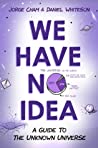
Jorge Cham (creator of PHD Comics) teams up with physicist Daniel Whiteson in We Have No Idea: A Guide to the Unknown Universe to survey the most fundamental open questions in physics and cosmology. The book is an enthusiastic, irreverent tour of everything scientists currently don’t understand about the universe — from the nature of dark matter and dark energy to why there is something rather than nothing. Rather than celebrating what physics has achieved, Cham and Whiteson deliberately spotlight the gaps, making a compelling case that the unknown dwarfs the known by a staggering margin. Their tone is conversational and self-deprecating, combining Cham’s cartoonish wit with Whiteson’s expertise to make genuinely difficult concepts accessible without dumbing them down.
The book moves through a series of big questions: What is dark matter? What is dark energy? Why does the universe have more matter than antimatter? What is space, really? What are the fundamental particles, and are there more we haven’t found? For each topic, the authors explain what physicists do know, candidly describe the limits of that knowledge, and sketch out the competing hypotheses that researchers are currently pursuing. The writing is peppered with analogies, jokes, and Cham’s characteristic stick-figure cartoons, which illustrate concepts ranging from particle collisions to the geometry of extra dimensions. The overall effect is something like a late-night conversation with a brilliant, candid scientist who is unafraid to say “we genuinely have no clue.”
What distinguishes the book from a standard pop-science primer is its philosophical undercurrent. Cham and Whiteson treat ignorance not as embarrassing but as exciting — as the frontier where science actually lives. They argue that acknowledging uncertainty honestly is a sign of intellectual health, and they gently push back against the tendency of popular science writing to oversell consensus and certainty. The result is a book that is both humbling and energizing, reminding readers that the universe remains deeply, delightfully mysterious.
Key takeaways
-
Most of the universe is unknown by mass-energy content. Ordinary matter — everything we can see and touch — makes up only about 5% of the universe. Dark matter (~27%) and dark energy (~68%) dominate, yet neither has been directly detected or explained at a fundamental level.
-
Dark matter is inferred, not observed. Its existence is supported by gravitational evidence (galaxy rotation curves, gravitational lensing, large-scale structure), but every direct-detection experiment so far has come up empty, leaving its particle nature completely open.
-
The matter-antimatter asymmetry is a genuine mystery. The Big Bang should have produced equal amounts of matter and antimatter, which would have annihilated each other entirely. That we exist means something broke the symmetry — but physicists don’t know what.
-
Space itself is not well understood. Questions about whether space is continuous or discrete, whether extra dimensions exist, and what “nothing” actually means remain unanswered. Even the concept of a vacuum turns out to be surprisingly complicated.
-
The particle zoo may be incomplete. The Standard Model is extraordinarily successful but almost certainly not the final word. Phenomena like neutrino mass, gravity’s weakness relative to other forces, and the hierarchy problem all suggest physics beyond the Standard Model — we just don’t know what that physics is.
-
Uncertainty is a feature, not a bug. The authors argue throughout that the frontiers of ignorance are where science is most alive, and that intellectual honesty about what we don’t know is more valuable — and more interesting — than false confidence about what we do.
-
Particle physics experiments are humanity’s most ambitious attempts at answers. Colliders like the LHC probe energy scales where new particles might appear, but so far post-Higgs results have been quiet, deepening rather than resolving the mystery of what lies beyond current models.