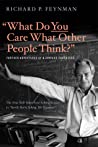
Richard Feynman’s second collection of autobiographical stories, assembled with his longtime collaborator Ralph Leighton, is in many ways a companion volume to the beloved Surely You’re Joking, Mr. Feynman! The book is organized in two broad parts: the first is a series of short personal anecdotes that showcase Feynman’s irrepressible curiosity, his irreverence toward authority and pretension, and his deep emotional life — qualities that his more boisterous public persona sometimes obscured. The second and longer part is a detailed, almost journalistic account of his work on the Presidential Commission investigating the Space Shuttle Challenger disaster of 1986. Together, the two halves paint a portrait of a man who brought the same unflinching honesty to personal grief and institutional failure that he brought to theoretical physics.
The book’s title comes from advice Feynman’s first wife, Arlene, gave him early in their relationship — a piece of wisdom that became a kind of life philosophy for him. The opening section dwells on Arlene with unusual tenderness. She was diagnosed with tuberculosis before they married, and Feynman married her anyway, over his family’s objections, tending to her through her illness while he was simultaneously working on the Manhattan Project at Los Alamos. Her death at twenty-five left a wound he describes quietly and without sentimentality, and it is in these passages that readers encounter a Feynman quite different from the laughing, bongo-playing trickster of the earlier book. Scattered among the Arlene stories are other short pieces — encounters with art, his complicated feelings about prizes and honors, and reflections on the relationship between science and meaning.
The Challenger section is where the book takes on a different character entirely. Feynman recounts being recruited onto the Rogers Commission, his skepticism about how such official investigations tend to work, and his determination to do real investigative work rather than produce a whitewashed report. He describes tracking down engineers, asking pointed questions about O-ring behavior at low temperatures, and performing his now-famous demonstration at a public hearing — dropping a piece of O-ring rubber into a glass of ice water to show how it loses resiliency in the cold, the very condition present on the morning of the launch. His account is both a detective story and a study in how bureaucratic cultures suppress dissent and tolerate known risks. He fought to include his own appendix in the final commission report, a document that stands as one of the clearest statements ever written about the difference between sound engineering judgment and wishful thinking driven by schedule pressure.
Key takeaways
-
The title is a life principle, not a boast. Arlene’s injunction to ignore what other people think was about intellectual and personal integrity — the courage to follow evidence and feeling honestly, regardless of social pressure or approval.
-
Feynman’s emotional depth is the book’s quiet revelation. His love for Arlene and the grief her death caused him are rendered with a plainness that is more moving than sentiment would be; the book insists he was as capable of vulnerability as of brilliance.
-
The Challenger disaster was foreseeable and foreseen. Engineers at Morton Thiokol had raised concerns about O-ring performance at low temperatures. The commission’s investigation — and Feynman’s appendix in particular — makes clear that NASA’s internal risk-assessment culture had become dangerously detached from technical reality.
-
Bureaucratic optimism is its own kind of danger. One of the book’s sharpest observations is how organizations under pressure begin to treat the absence of a previous catastrophe as evidence that a known risk is acceptable, a form of reasoning that quietly lowers the bar each time disaster is avoided.
-
Independent inquiry requires stubbornness. Feynman had to fight to pursue his own lines of investigation rather than follow the commission’s more choreographed process, and he had to fight again to get his dissenting appendix included in the final report. His famous ice-water demonstration was, in part, a way of making a technical point undeniable on camera.
-
Science depends on honest uncertainty. The appendix Feynman insisted on appending to the commission report ends with a line that has become one of his most quoted: “For a successful technology, reality must take precedence over public relations, for Nature cannot be fooled.”
-
Feynman was ambivalent about honor and recognition. Several shorter pieces in the first half of the book deal with his discomfort with prizes, ceremonies, and the cult of the genius scientist — attitudes that sit in interesting tension with his evident enjoyment of fame when it let him do things like play bongos or pick locks.